Fi Jae Lee
Everything Ascending to Heaven Smells Rotten no. 3 Everything Ascending to Heaven Smells Rotten no. 2 Everything Ascending to Heaven Smells Rotten My Shrine Mememememememe Candle Louis XIV-Bodhisattva Bell in the Water The Intestine Woman My Moth Drawing for Quira Fountain Solo Show at Cecille. R. Hunt Gallery in Webster University, St. Louis Quira Fountain Swirling on Her Head* Swirling on Her Head Le Massacre de Jesus Egoiste II - The MFA Graduation Show Le Massacre de Jesus Egoiste "Sk/in & Out" The Wing Woman LouisXIV-Bodhisattva The Chair for the Wing Woman The Chair for the Womb Woman The Chair for the Intestine Woman The Nose Cloud The Eye Cloud The Intestine Woman The Squid Buddha Fish-Worm-Tree My Shrine Installation 2004 Womb Mom, Crucified Bury Him! Moth Paul Cezanne - Basket of Apples Self Portrait The Stairway Man
My Monkey to the West


I wish to travel back time. I want to escape from the current art works in Korea that appear like handicrafts by putting a moment in everyday life, a specific moment in time, to a stand-still. I also want to hold protracted time, wound round and round a thread holder, in my arms. I want to bring together the time dedicated to my work without having to divide it up. I wish to load my own narrative onto each piece of work as does a roaming peddler who moves from one village to another loaded with a variety of goods for everyday use. I wish to move grudgingly forward in this world while bearing the growing weight of the load of narratives.
For the past year, I have been reading ever so slowly the ten-volume work by Wu Chengen, Suh You Gi(monkey to the West), published by Moonji Publishing. Monk Samjang and his fellow travellers are on their way to the world of heaven to rescue the dead who have yet to undergo rebirth after having arrived in the land of the dead. Since I am half way through the story, strictly speaking, they have not yet reached the west. I am afraid they may never reach their destination. The reason is that life-threatening adventures await them at every corner. But like those who have been to the West, I am rather at ease with reading about their adventures. I have always believed it is not about reaching one's destination, rather the course of overcoming any stumbling blocks along the way that matters. Every time, they overcome one hurdle, they unravel one Chinese fantasy after another into the air. There is a monster in every fantasy adventure. In this case, the monster makes its grand appearance clothed in the scales of a dragon or a gold armor, but he turns into a sorry piece of creature after being attacked by the monk and his entourage. He seems to represent vestiges of my past moments of anger or anxiety. By reading the story, I am reliving my own version of monkey to the West. In the present exhibition, I intend to deliver a monologue on my very own monkey to the West.
I destroyed the majority of my installation pieces after returning from the United States. While immersed in a new work, I sometimes called forth and shattered the specters(monsters) of my time past. It was like reading my inner book of monkey to the West.
The monk is leading his gang of friends, while I cradle a black-haired and warm-blooded animal in my arms. This animal has remained a source of energy even before I was born. While living in the US, I was constantly caught in between a state of separation. Every night, I suffered from nightmares and severe pre-menstrual cramps from my residence that overlooked the grandiose sea-like Lake Michigan or the Hudson River. Whenever I took a dose of traditional medicine from home, the symptoms receded and as time went on, they came back in waves of pain. On the trees that lined the street under my doorstep, a flock of crows sat down and were noisily predicting my death in the near future. I once watched a documentary film on people with visual or auditory impairments. After having recovered their lost sensory capacities through an operation, they suffered more acutely from the sudden deluge of light or sound than when they had lived with the disabilities. Our senses both require the ability to sense as well as to edit. I was shuddering under the unfamiliar environment and language much like people with such disabilities. I wanted to materialize the chaotic state in my work.
At times, I had the feeling that I was like a woman living inside a mirror. I tended to forget while I was immersed in the work at the studio, but once in front of the mirror, I clearly saw a small Asian woman who was wearing the name tag of 'a foreigner'. I once read an article that seeing determined one's identity, and I sensed that the West seen through my eyes or the West that I was identifying with was constantly in conflict with my skin and image as a foreigner. The travelling gang led by the monk on its way to India was created by the author, Wu Chengen, while he himself was writing the narrative in a secluded room in the Ming dynasty. Similarly, one half of myself was in a foreign land. But I had the illusion that my other half was working on the piece in a location outside the mirror, far closer to where my parents were living. At such moments, I closed my eyes and imagined myself to be in a faraway place outside the black mirror.
At first, I created an altar for the goddess who was calling me from afar. The triangular horns hanging on the breasts of the goddess whom I had created in the solitary nights was making swooshing sounds to the far-out-there me. I even attached an electrical device to allow the goddess, the integration of my own solitariness, to walk around and sing to herself (<My Shrine>). Once the altar was lighted, I was able to come face to face with the solitary and cruel Jesus who was deeply seated inside me (<The Selfish Jesus>) and Louis XIV (<Louis XIV>) or even the woman with her intestines deprived of her skin (<The Intestine Woman>). I also met the moth decorated with my diaries around its body (<My Moth>). They represented my proud self who was visible if my outer skin was peeled off and the proud proprietor of the private inner world underneath the skin. I held a party entitled <Le Massacre de Jesus Egoïste> where I stood in the middle of the fountain of wine with which to anoint the participants and I cut the doll's hair with the huge scissors of my body. I was constantly taking out the reddish black stuff that was crying in the midst of the outer layer of the Asian woman.
I had the sense that I was slowly swimming in cold jelly or I was covered in mercury underneath the mirror. While my body was placed in a remote location, in a small place in Asia, I was unable to overcome the time difference awash in the transparent jelly. I wrote a letter to my mother. 'Mom, did you know that the taste of jelly is different in each region and each country? Those sold at the Centre Pompidou tastes rather sour, and those sold at the cafeteria in the University of Chicago is so crumbly. Besides, you can't imagine the amount of sugar that is thickly slopped over. I remember the jelly sold in Seoul which was so tough like plastic' (<mememememememememe candle>). I was wandering in between seeing and being seen, inside and outside, god and human, the West and the East, and between the skin and under the skin. I didn't realize that there was such a distance between the skin and underneath the skin. I was separated into two existences like that (<Sk/in & Out>). I was there 'in' and 'out' there at the same time. Or sometimes I wasn't even there. I was dismembered into the 'I' that was headed to the West with the intention to create a 'being' and the 'I' that was veering toward 'non-being' which assumed the form of warm, black energy. I created a huge collection of creations that took the form of small living creatures that were nothing of this world in the process of such an disintegration. My small efforts over time resulted in a huge integrated work. I collected small units of solitariness and dissociation to produce a larger piece.
Where no one was seen wandering, in between the front and the back of the mirror, in the darker place between the skin and intestines, between a glacier and another, the crevice deeply cut was my own living space. I met the tree standing with its top on the ground upside down. The upside-down tree that was taking bab(nutrition) to its mouth whenever it was hungry by reaching out its hands, I hung a light fixture inside the tummy and head of the tree. As I was doing so, I had the feeling that all the trees of this world had their heads to the ground so their mouths, noses and even their eyes were headed down and they were moving their bodies with their thighs wide open toward the sky. I hung fish and berries on the bodies of the trees (<Swirling on her Heads>).
I thought about the first female figure in Korean mythology. She revealed herself in the birth myth of our nation. She transformed herself from a bear to a human being after overcoming hardship, but she disappeared from mythology after giving birth to a son. From a human perspective, she can be seen as a foreign creature from a far away place, like myself. I worked on a piece in which she as a human being was springing forth from the body of the bear. I engraved her skin with images of plants, animals and sea creatures to hang outside her. I created her existence in between the skin and the fountain. I wanted to titillate the senses of the visitors. Through light, sound, and the revolving red water and the image of the fountain (<Quira fountain>).
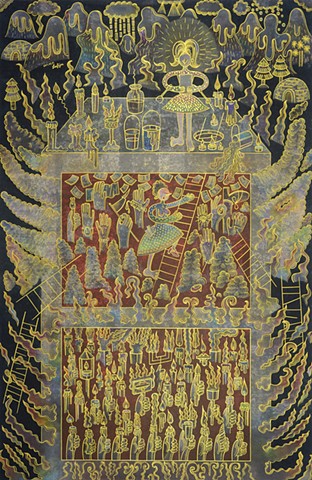
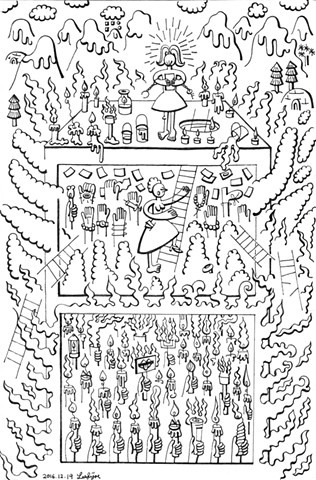
As soon as I returned to Seoul, I went to observe a demonstration scene. One of the most memorable images of that night was not the sight of burning candles, but the smell of slightly scorched dried squid on the portable stove in the middle of the street at the time when the demonstration was at a stand still. Dried squid is one of the most detested food of foreigners. They hate the smell of dried squid on an open fire because it reminds them of cadavers being burned. In Twenty Thousand Leagues under the Sea, the squid is a creature to be decimated. In a sense, the border of a community can be translated into boundaries of the senses. The reeking odor of grilled squid is the other as well as the abjection of the West. In spite of that, Seoul was welcoming me, the stranger of the West, with its odor. It felt as if the squid was the resilient 'time' muscle of Seoulites and represented the vibrancy of a soon-to-be-launched space vessel. I conjured up an entity fitted with both a space vessel and the muscle. The squid can be compared to a star with self-luminescent ability in the deep seas. Unfortunately, it has lost the ground for its existence in the deep seas by being drawn to lightings hanging from fishing vessels and being turned into either the object of aversion or preference. The squid talked to me. "Each luminescent cell in my body throbs at each heart beat. At that instance, huge orbs of light fall from the sky. Soon, I will be saved. I shall be saved from the oppressing, fearful and cold darkness. I expel every ounce of utmost darkness that remains in my body. At the same time, a sharp hook pierces my body. It is painful. The sharp pain draws me toward the light. Whatever ascends to heaven carries an odor." I wanted to juxtapose the legs of the dried squid with those of the giant squid resembling a big space vessel to remind us of the forlorn deep seas that remained waiting outside my body (<Bell in the Water>). My mother was muttering while spraying the room with air freshener. "Your work space reeks of putrefying smell."
Even to this day when I am writing this piece, I wonder what I or the monk and his entourage have gone in search of in the West only to return to the point of departure. Perhaps I was looking for the holy bible hidden in the depth of the dark light in the deep seas. At present, I have the fleeting sensation of having glimpsed the glint of the eyes or the lingering image of the self-illuminating creature in the dark that seems to be there or not there.